|
|
|
|
St. Bartholomew School
470 Ryders Lane
East Brunswick, NJ 08816
Dear 5th grade
class:
Wow, you guys really know
how to ask questions! Let me
try to answer all of your questions in one letter.
I am happy to hear that you
guys care for animals.
Part of the joy of getting to do what we do is working with animals.
A lot of your questions relate to sick animals.
We vaccinate our calves against diseases that cattle can get.
They don’t get measles or polio, but get diseases with strange names such
as Leptospirosis, IBR, BVD and Blackleg If
a calf does get sick, we provide medicines to keep them well just as your doctor
does for you, but our calves seldom get sick on the ranch.
One of you talked about
keeping people away from animals so the animals won’t get sick.
Our animals live out on the pasture.
It takes from 25 to 40 acres to supply grass for a cow and her calf.
This is a very healthy environment and they are not in danger of getting
sick from humans. Calves
also get a natural immunity from their mother’s milk just as humans do.
If you will think about how
you get sick, you will realize that it is often because the person next to you
in class has been sick. If
each room had just one person in it, you probably wouldn’t get sick as often.
On the ranch, cattle have lots of fresh air and sunshine and are not
crowded in confined places; so, they do not often get sick.
The world is designed so
beautifully that we are able to use nature’s renewable resource of grass to
produce the highest quality protein—beef.
There is no other use for this grass and grass actually does better when
properly grazed. During the
summer, it provides all of the nutrition the cattle need and we don’t feed them
anything with the grass they graze.
There was concern about
predators. We do have
coyotes, but they don’t really bother the cattle.
If there is a sick calf that we don’t find to doctor or care for,
occasionally the coyotes will get it.
But we work hard to make sure that we care for the sick calves and this
doesn’t happen. Likewise, if
an animal gets hurt, we doctor it and care for it until it gets well.
Fortunately, cattle do not get hurt very often.
Most of what hurts you is man-made.
Our cattle are not around pavement or roads and do not climb on fences or
jungle gyms. Cattle do not
hurt each other.
Probably the worst predator
is worms. Cattle can get a
stomach worm from eating grass that has the worm’s eggs on it.
This worm lives off the animal which means that the feed feeds the animal
and the worm. We
utilize a wormer when we gather the cattle to keep this from happening.
There are expenses in
running a ranch. We have to
utilize either windmills or solar wells to provide water for our cattle.
Water is as important as grass.
In the winter, we provide a protein supplement with minerals so the
cattle will have all of their needs met. The
main ingredient for protein is a byproduct of cotton, made from the cotton
seeds. We feed about two pounds of
this per cow per day throughout the winter.
They get everything else they need from the grass even though it is
dormant.
Keeping fences up and in
good condition is another substantial expense.
We utilize fences to control grazing; so, pastures can rest and the grass
can stay healthy.
I was asked about training
cattle. We do not train the
cattle. They live in the wild
and are happiest when we don’t mess with them.
There is nothing that we could train them to do that they can’t do on
their own. The cattle do
learn to come to the pickup in the winter to get their protein (we call these
pellets “cake”). We blow a
siren that sounds like a police siren and the cattle come to eat.
The cake tastes so good, they quickly learn what the siren means.
Cattle are normally gentle.
We work hard not to scare them and if the cowboys do their job, the
cattle are very tame even when people are around.
When we feed our cattle during the winter, we get out and walk among the
cattle. In this way, they
associate humans with the good experience of eating the “cake”.
We round up our cattle
twice a year. Cowboys
ride horses and the cattle have natural herd instincts that allow the cowboys to
gather them to the pens.
The first time is so we can brand and vaccinate the calves.
The second time is to wean the calves from their mothers.
We separate them across a fence and have found that, in this way, they
readily give up their mother’s milk (giving her a much needed rest) while still
having the security of their mother nearby.
After three or four days, they forget about their mother and are
contented eating the grass.
We wean them when they are six to seven months old, so they already have
been getting most of their nutrition from the grass.
We use two types of
identification for our cattle.
The first is a brand.
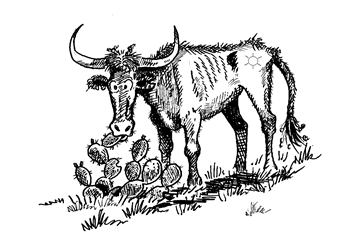
One is the sunshine you see on the cartoon cow on my letter head.
These let other people know that these are our cattle.
Unfortunately, there are still rustlers and the brand helps keep them
from stealing and selling our cattle.
The second type of identification is an ear tag (sort of like an earring)
that has a number on it. This
is usually a four digit number and the first number is the year in which the
animal is born. The other three
digits let us keep track of this particular animal.
So 4135 would be the 135th animal that was born in 2014.
With our records, we know what medicine or vaccines an animal has
received, when it had calves and other information.
The number is like a name.
When cattle leave our ranch
they go to feedlots where they are fed a corn based ration.
This ration is scientifically formulated to provide everything the cattle
need to do well. An average
animal will eat 24-30 pounds of feed per day and they are fed two times per day
in the feedlot. Originally,
feedlots were used because all of the cattle came in the fall of the year and
this made the market a lot lower in the fall.
By feeding the cattle another four to six months, the cattle could be
harvested at a time when there wasn’t much beef available and the market was
higher. People found that an
added advantage was that corn fed beef tastes a lot better; so, it was a win-win
to feed the cattle.
We allow people to hunt
deer wild turkeys and quail.
All of these occur naturally on the ranch and they eat the weeds and
trees that grow there. We
restrict the harvest; so, we will have sustainable numbers for future
generations. All are very
tasty.
I have five grandchildren
who are from five to nine years old.
Already, they own part of the ranch and everything I do is aimed at
assuring that they will be able to care for the animals and the land just as I
do. I am not interested in
selling my ranch, but if my grandchildren don’t want to run the ranch, I hope
they will sell it to someone who derives as much pleasure as I do from being a
good steward of the land and animals.